YouTube wants a share of India's shopping carts. Will ad budgets follow?
With retail partnerships and creator commissions, YouTube is moving deeper into India's commerce ecosystem; questions remain about advertising budgets, creator earnings & who really drives a purchase
 by
Published: Oct 19, 2026 8:59 AM | 6 min read
 Follow Us

- YouTube is expanding its Shopping affiliate program in India, adding new partners like Amazon and Tata CLiQ to enhance the shopping experience for its users, who are increasingly using the platform for product research.
- The program allows creators to tag products in their videos, enabling viewers to purchase them from participating retailers, with creators earning commissions on qualifying sales.
- YouTube reports significant growth in shopping-related activity, with over 450 million users conducting shopping searches and a 55% increase in shopping-related watch time year-on-year.
- Concerns remain about the effectiveness of attributing sales to specific creators, as multiple influences can lead to a purchase, raising questions about the trust and independence of creators in affiliate marketing.
YouTube has spent years learning what Indians like to watch. Now, it wants to know what they'll buy.
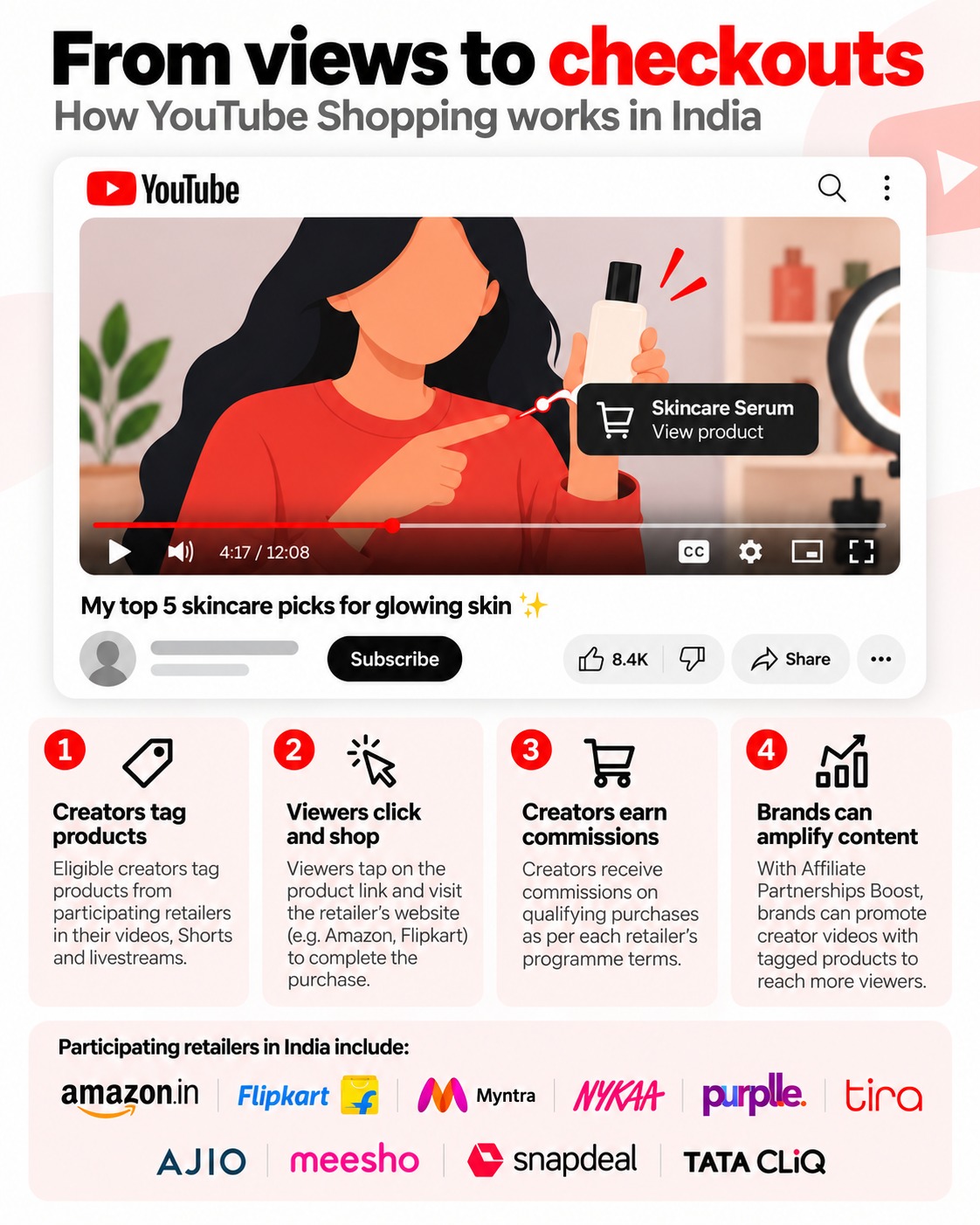
The Google-owned video platform is expanding its Shopping affiliate programme in India, adding Amazon, AJIO, Meesho, Snapdeal and Tata CLiQ to an ecosystem that already includes Flipkart, Myntra, Nykaa, Purplle, Shopsy and Tira. Announced in September, the new partnerships are being rolled out as YouTube looks to shorten the distance between watching a product review and purchasing the product itself.
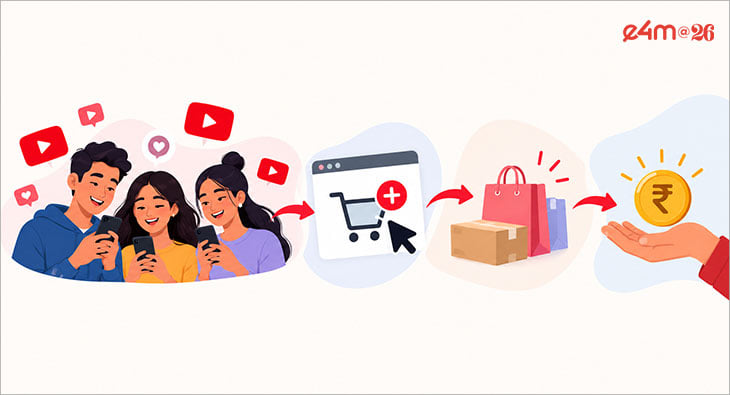
The proposition is straightforward. Creators tag products in their videos, Shorts and livestreams, viewers follow those links to participating retailers, and creators earn commissions on qualifying purchases. The transaction still happens on the retailer's website, but the journey increasingly begins on YouTube.
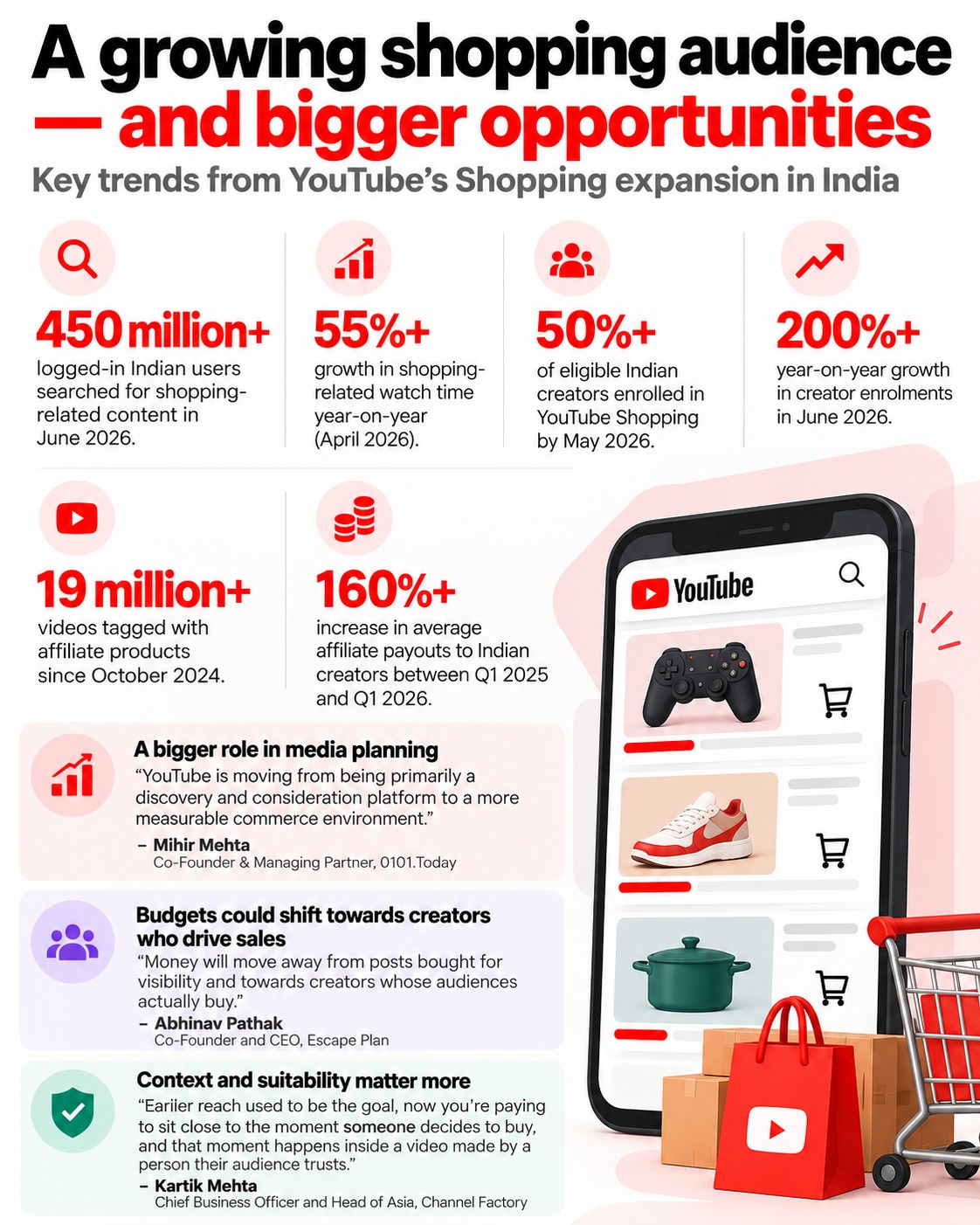
The scale is considerable. According to YouTube, more than 450 million logged-in Indian users conducted shopping-related searches on the platform in June 2026, while shopping-related watch time grew over 55% year-on-year in April. More than half of eligible Indian creators had enrolled in YouTube Shopping by May, with enrolments rising over 200% year-on-year in June. Over 19 million videos have been tagged with affiliate products since the programme's October 2024 launch.
Average affiliate payouts to Indian creators also grew more than 160% between the first quarters of 2025 and 2026.
Those are impressive numbers. What they don't reveal is how many purchases were actually generated, how much incremental revenue retailers earned, or whether advertisers are moving budgets accordingly.
How much control is Google giving advertisers over ad budgets? Read more here
Read more: Is retail media overcrowding the digital shelf?
A deep dive into how YouTube is changing success
From attention to transactions
YouTube's advantage is that consumers already use it to research products, compare alternatives and seek recommendations. A smartphone review, skincare tutorial or travel equipment demonstration can influence buying decisions long before a consumer reaches an online marketplace.
Affiliate shopping gives YouTube a mechanism to monetise that influence more directly.
“Search has traditionally been where marketers capture declared intent, while retail media captures shoppers closest to transaction,” explains Mihir Mehta, Co-Founder and Managing Partner, 0101.Today.
“YouTube now has the ability to sit earlier in the journey, where creators shape preference, while also creating a more attributable path to purchase,” he added.
For advertisers, that potentially changes how video is evaluated. Alongside reach, engagement and completed views, brands can examine product interactions, attributed sales and assisted conversions.
YouTube is also introducing Affiliate Partnerships Boost, allowing brands to amplify organic creator videos featuring tagged products through paid campaigns. Nykaa has been identified as an early Indian advertiser planning to use the capability during the festive season.
The distinction between influencer content and performance advertising, already increasingly porous, becomes harder to maintain.
Kartik Mehta, Chief Business Officer and Head of Asia, Channel Factory, believes this makes the context surrounding advertisements increasingly important.
“Earlier reach used to be the goal, now you're paying to sit close to the moment someone decides to buy, and that moment happens inside a video made by a person their audience trusts.”
He argues that advertisers will need to evaluate individual videos for brand suitability, rather than relying solely on broad keyword-based exclusions.
Will advertising budgets follow?
For brands, the attraction of affiliate commerce is measurable commercial activity rather than engagement alone.
Abhinav Pathak, Co-Founder and CEO, Escape Plan, believes this will influence where brands allocate creator budgets. “Money will move away from posts bought for visibility and towards creators whose audiences actually buy,” he says.
Escape Plan operates its own creator programme, offering commissions of up to 10% on qualifying sales. Commissions are confirmed after a 30-day return window, allowing the company to account for returned purchases before paying creators.
The programme illustrates how brands can build performance-linked creator relationships, although it is separate from YouTube's affiliate infrastructure.
For smaller creators, such arrangements could also reduce the importance of follower counts in securing commercial opportunities. YouTube lowered its affiliate eligibility threshold in March 2026 to include qualifying Partner Programme creators with at least 500 subscribers.
However, not everyone expects commission-based partnerships to replace established influencer arrangements.
“I wouldn't say we're moving away from fixed brand deals. If anything, we're seeing another revenue model being added to the creator economy,” says Anindita Lal, Vice President, Brand Solutions & Operations, Qoruz.
She expects hybrid arrangements, where creators receive fixed fees for content alongside commissions on attributable purchases.
The economics are particularly interesting for evergreen content. A detailed smartphone comparison published today could continue generating affiliate income months later, without requiring another sponsorship agreement.
Yasin Hamidani, Director, Media Care Brand Solutions, similarly sees affiliate commerce complementing fixed-fee collaborations, especially in high-intent categories such as beauty, fashion and electronics.
Who really influenced the purchase?
There is, however, a problem with treating an attributable transaction as definitive proof of marketing effectiveness.
A consumer might discover a product through Instagram, research it through several YouTube reviews, discuss it with friends and eventually purchase through one creator's affiliate link.
The final creator receives the commission. But that doesn't establish who created the demand.
“Just because a creator generated the final sale doesn't mean they were the only person who influenced that purchase,” Lal points out. “There's a difference between generating a transaction and building purchase confidence.”
This distinction matters when brands begin comparing creators primarily through sales metrics. Last-click attribution can identify a transaction pathway without establishing whether the advertising generated an additional purchase that otherwise would not have happened.
It also raises questions about creator independence.
If higher commissions encourage creators to recommend products they would otherwise ignore, the trust underpinning affiliate commerce could weaken.
“The risk begins when the commission starts deciding what the creator recommends,” Lal says.
Hamidani agrees that creators will need to remain selective about endorsements and transparent about commercial relationships.
There are practical limitations, too. Participating retailers determine commission rates and attribution windows, while cancellations and returns can reverse earnings. YouTube also acknowledges that its current enhanced commission arrangements are temporary.
Globally, YouTube says more than 1.3 million creators participate in its affiliate programme, with gross merchandise value growing thirteenfold over two years. Comparable India-specific GMV and conversion figures have not been disclosed.
When contacted by exchange4media for additional information, YouTube referred the publication to its official announcement.
For now, the expansion is less evidence of advertising budgets abandoning traditional channels than of another powerful platform positioning itself closer to the purchase.
The opportunity is considerable. So is the unresolved question: measuring which creator closed a sale is relatively straightforward. Establishing who persuaded someone to buy remains rather more complicated.
Read more news about Digital Media, Internet Advertising, Marketing News, Television Media, Radio Media
For more updates, be socially connected with us onInstagram, LinkedIn, Twitter, Facebook, YouTube & Google News